The Vacuum Effect: Why Waterproof Enclosures Fail
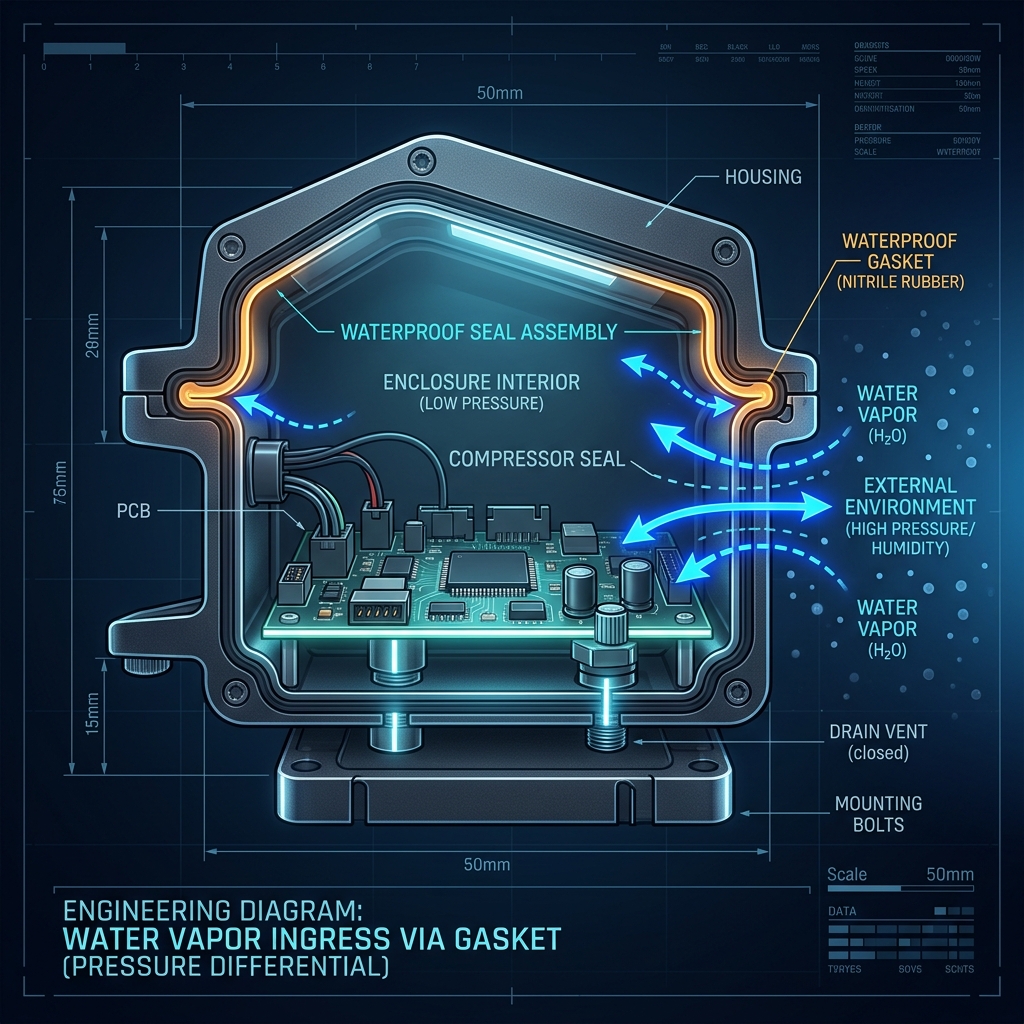
Have you ever designed a perfectly waterproof outdoor electronic enclosure...
Only to open it a few months later and find it completely flooded with water?
You probably blamed the rubber gasket. But it didn't leak. It pumped the water in itself. 👇
It is a thermodynamic trap called "The Vacuum Effect."
Imagine a sealed digital kiosk or an outdoor electronic housing.
During the day, the sun heats the outer panels, and the internal electronics generate their own heat.
According to Gay-Lussac’s Law (P1 / T1 = P2 / T2), as the internal temperature increases, the air pressure skyrockets.
This high pressure forces hot, expanding air to push its way out of the box through microscopic imperfections in your rubber seals.
But the real danger happens at night.
When the sun goes down, the temperature drops rapidly. The remaining air inside the enclosure cools down and contracts.
This creates a massive internal vacuum.
If it rains, or if morning dew gathers on the outside of your device, that internal vacuum literally SUCKS the water right past your gaskets and into your enclosure.
This cycle repeats every single day. The housing acts like a slow-motion water pump, dragging in a few drops at a time until the PCB finally shorts out.
To design outdoor enclosures that actually survive, follow these 3 rules:
𝟭. 𝗦𝘁𝗼𝗽 𝗦𝗲𝗮𝗹𝗶𝗻𝗴 𝗜𝘁 (𝗕𝗿𝗲𝗮𝘁𝗵𝗲𝗿 𝗩𝗲𝗻𝘁𝘀)
You cannot fight thermodynamics. Instead of making the box airtight, add a PTFE pressure equalization vent. These micro-porous patches allow air to freely flow in and out to balance the pressure, but the pores are too small for liquid water to pass through.
𝟮. 𝗗𝗿𝗶𝗽 𝗟𝗼𝗼𝗽𝘀 𝗼𝗻 𝗖𝗮𝗯𝗹𝗲𝘀
Water will always follow a wire. If a power cable enters your enclosure from the top, it acts like a water slide. Always route cables so they dip below the entry point before going inside. Gravity will force the water to drip off the bottom of the loop.
𝟯. 𝗖𝗼𝗻𝗳𝗼𝗿𝗺𝗮𝗹 𝗖𝗼𝗮𝘁𝗶𝗻𝗴
Assume water will eventually get in. Always specify a thin layer of conformal coating (like silicone or acrylic) over your circuit boards. This ensures that even if condensation forms, the delicate electronics are shielded from a short circuit.
Have you ever had an IP-rated enclosure fail in the field? How did you solve it? Let me know below! 👇
Related Articles
Why Do "Ergonomic" Snap-Fits Suddenly Require a Hammer on the Assembly Line?
Deflection force is not mating force. Understand the Coulomb friction model and how lead angles exponentially amplify push force.
The Science Behind the Living Hinge
The 'living hinge' is an engineering paradox. If you take a thick piece of plastic and bend it, it breaks. But if you make it just 0.30mm thin, it lasts forever. Here is the science behind it.
Sheet Metal Bend Relief: Why Corners Tear
Have you ever designed a sheet metal box in CAD only to have the factory call and say the corners are tearing? You probably forgot to add a Bend Relief. Here is why metal rips.
Have a product challenge like this?
We help hardware teams solve complex engineering, DFM, and production challenges every day.
Discuss Your Project