Weld Lines: The Invisible Weakness in Plastic Parts
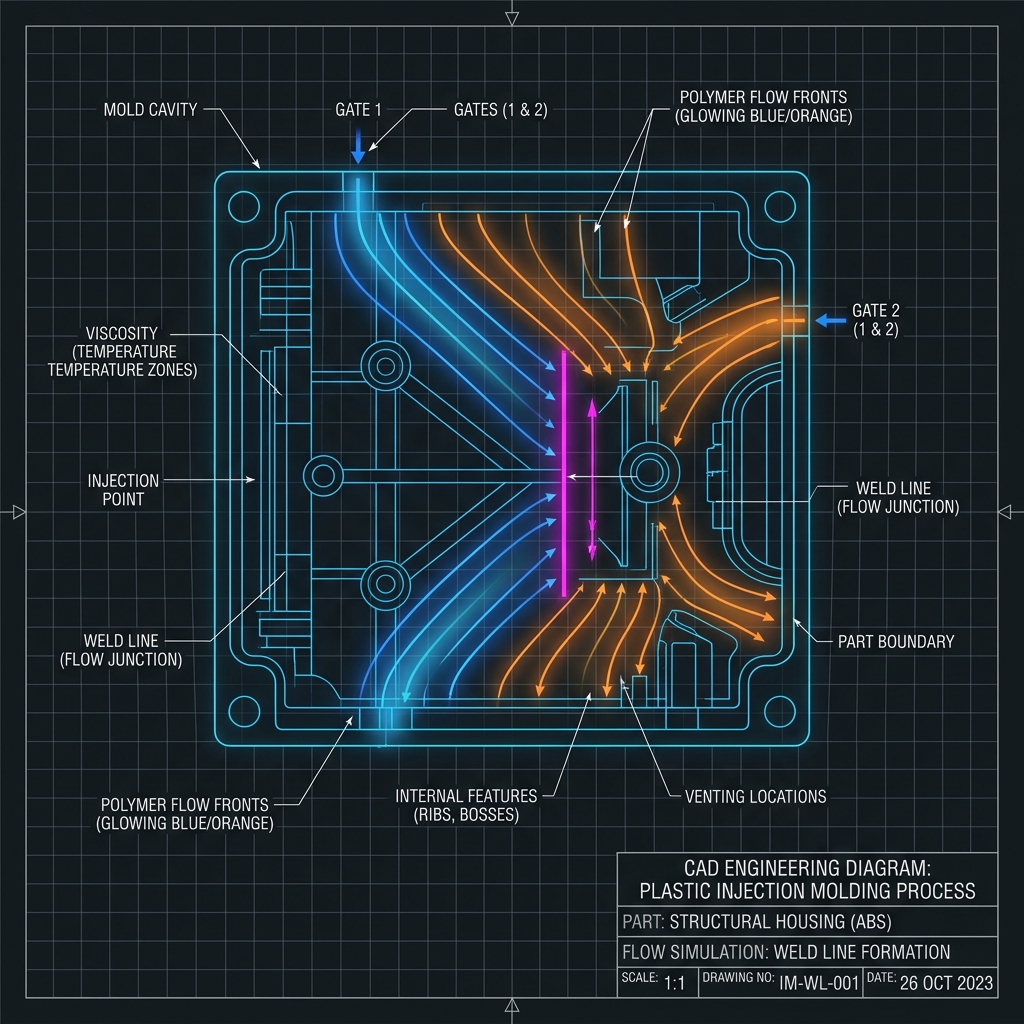
Have you ever drop-tested a thick plastic enclosure...
And it randomly shattered in a perfectly straight line?
You probably ignored the invisible weakness of a Weld Line. Here is the science behind it. 👇
When new engineers design a plastic part with a hole or a screen cutout, they assume the plastic acts like liquid metal.
But molten polymer is highly viscous. When it hits an obstacle (like a button hole), the flow front splits in two.
When those two rivers of plastic meet back up on the other side, they don't magically fuse back into one solid piece.
They just smash together, creating a microscopic seam called a Weld Line (or Knit Line).
Why is it so weak? It comes down to Polymer Chain Entanglement.
As plastic flows through a cold steel mold, the leading edge of the flow cools down rapidly.
By the time the two flow fronts finally meet, they are often too cold for their molecular chains to cross over and tangle together.
Instead of a solid wall, you get a microscopic "V-notch" trench on the surface. Under stress, this notch acts as a crack initiator, snapping the part with almost no effort.
If you are designing plastic enclosures, follow these 3 rules to fight weld lines:
𝟭. 𝗠𝗼𝘃𝗲 𝘁𝗵𝗲 𝗚𝗮𝘁𝗲
You cannot eliminate a weld line if there is a hole in your part. But you CAN control where it forms. By moving the injection gate in CAD, you can force the weld line to form in a thick, low-stress area instead of right on a critical mounting tab.
𝟮. 𝗧𝘂𝗿𝗻 𝗨𝗽 𝘁𝗵𝗲 𝗛𝗲𝗮𝘁 𝗮𝗻𝗱 𝗦𝗽𝗲𝗲𝗱
The hotter the flow fronts are when they meet, the more the molecules will entangle. Work with your molder to increase the melt temperature or the injection speed so the plastic doesn't have time to freeze before it fuses.
𝟯. 𝗩𝗲𝗻𝘁 𝘁𝗵𝗲 𝗦𝗲𝗮𝗺
When two flow fronts smash together, they trap ambient air between them. If that air cannot escape, it acts like an invisible wall preventing the plastic from mixing. You must add a microscopic vent in the tool steel exactly where the lines meet.
Have you ever had a plastic part fail exactly on a weld line? How did you fix it? Let me know below! 👇
Related Articles
Draft Angles: Solving Vacuum Lock in Injection Molding
Have you ever stacked two plastic buckets together and couldn't pull them apart? That frustrating vacuum lock is exactly what happens inside an injection mold, unless you use a simple design trick called a 'Draft Angle'.
Forced Ejection: Mass-Producing Undercuts Without Expensive Molds
How do they mass-produce cheap plastic bottle caps without using crazy expensive molds? They don't unscrew the plastic from the steel. They just yank it off. It’s an engineering trick called 'Forced Ejection'.
The 85/15 Rule: Why Top Engineers Miss Deadlines
Why do top-performing engineers suddenly start missing critical deadlines? You might assume they lost their motivation or got distracted. But most of the time, they are just fighting a broken system.
Have a product challenge like this?
We help hardware teams solve complex engineering, DFM, and production challenges every day.
Discuss Your Project